William James
By all reports, William James Meadows, born in 1753, (or 1751 according to 1841 census), was surely the most colourful of all our ancestors. From a very young age, he seems to have demonstrated his penchant for the unconventional. His grandson’s notes recount an incident when, caught by his mother after having swum across the Thames to avoid a toll, he was frog-marched home in his birthday suit.
William James lived for a while at his father’s inn at Rottingdean nr. Brighton. At one point, he had a share in a lugger and was involved (as many others at that time) in contraband. It seems that it was customary for the local excise man to be entertained in the Inn by Thomas, whilst William ferried his booty. A change in customs men led to William leaving the area at some haste – perhaps it was then he first went to Dublin?
The notes suggest that William – like his older brother Thomas – sailed with Cook; but left the ship due to a falling out with the boatswain. It’s difficult to fit this account into the context of his stage career, perhaps there was confusion between the two brothers? What does seem clear is that he made his stage debut, aged about 20, in Brighton as ‘Young Meadows’ in the popular 18th century comic opera, ‘Love in a Village’.
William James was probably married in his early twenties, given reports of his daughters acting alongside him as early as 1794. His wife, Margaret Siddall, had the misfortune to lose her mother in a sad accident: family tradition says that she was shot by her own husband, an armourer at the Tower of London. Her father was probably William Siddall, a gunsmith of Nantwich in Cheshire. His first wife, Mary, died between 1760 and 1768, and a gunsmith may well be the origin of the family’s armourer (the Nantwich records). Margaret was evidently a spirited lady, as Edwin Lewis’ anecdote about her bold handling of a highwayman illustrates.
The Nantwich records
William Siddall, a blacksmith of 25, married Mary Swinnerton, 22, of Betley in Staffordshire, at Nantwich on 31 December 1758, and Margaret, daughter of William Siddall, gunsmith, was baptised there on 16 May 1760 (Cheshire parish registers and Bishop’s Transcripts).
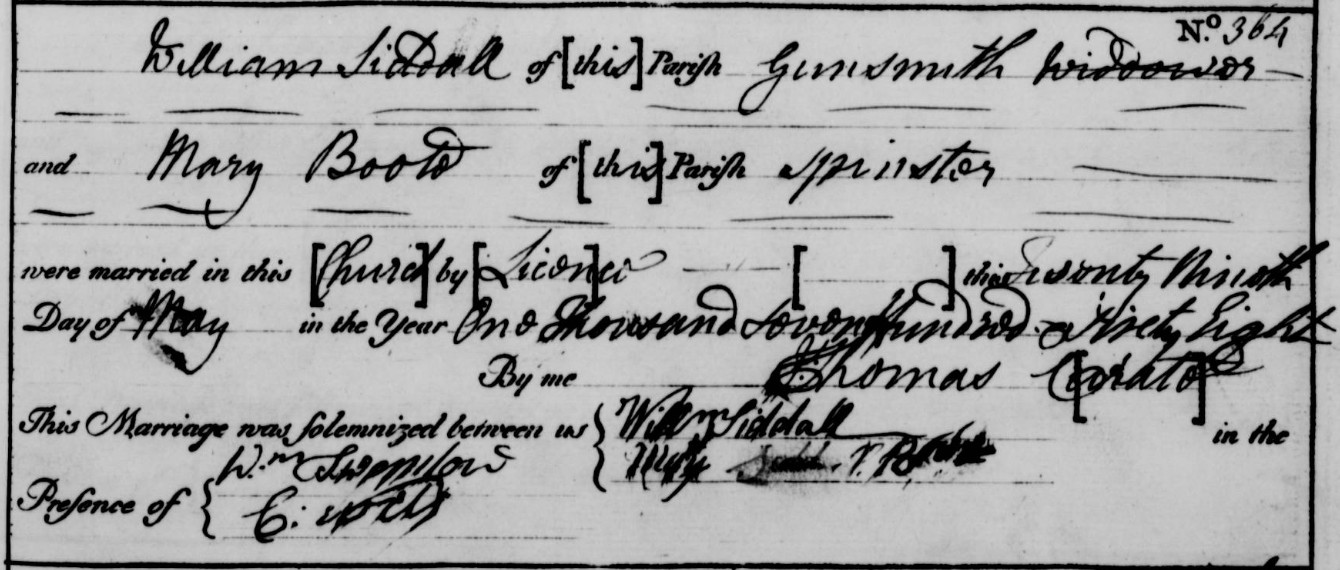
By 1768 William was a widower. On 25 May he swore that he was “thirty four years and upwards” and wished to marry Mary Boote, a spinster of twenty-three from the same town, and four days later, on 29 May, they were married by licence in Nantwich church. He signed both documents himself, as Willm Siddall, which is why that spelling is used throughout this site; the clerks who wrote the other records spelt the name Siddale, Syddall or Syddal, and the family remembered it as Syddle (Cheshire marriage licence allegations and Nantwich parish register).

In 1771 he was still a gunsmith at Nantwich, taking John Woodcock as his apprentice for a premium of £15 (Country Apprentices, TNA IR 1/58/11). Further children, William (1771), Mary (1777) and Ralph (1782), were baptised at Nantwich, he paid land tax there in the early 1780s, and a William Siddall was a tenant in Hospital Street in 1791.
No burial has been found for Mary, his first wife. She is not in the Nantwich burial registers for 1759 to 1769, and the Cheshire coroners’ inquests for those years have not survived, so the story of the shooting can be neither proved nor disproved. Nothing yet places William at the Tower of London; in the retelling, a country gunsmith may well have become the family’s armourer.
Margaret and the highwayman
Edwin Lewis heard this story from his father, James, and wrote it down in his notebook:
I never heard much of my paternal grandmother, except that she was a woman of some character and nerve, and my father used to tell the following anecdote in confirmation. About this time or soon after they were living at Winchmoor Hill, and on one occasion she was being driven home by a neighbour, when they were stoped by armed highwaymen, with the usual pistol &c. Her companion had a considerable amount of money with him which he had taken the precaution to hide under the seat, only retaining sufficient in his purse for the tolls and other slight costs of the road, but on being stopped appeared to have been quite unnerved dropping his reins &c and becoming prostrate with fright, but the lady was equal to the occasion, and beging the thief not to frighten her husband who was not well, said of course they must deliver what little they had, and proceeded to induce the gentleman to give what he had in his pockets, together with the contents of her own, beging the highwayman to allow her to retain a few coins which belonged to her children, which he readily consented to do, saying he had children of his own, and so after getting him to hand her the discarded reins drove off with the greater valuables.
From Edwin Lewis’ Notebook.
William James’s stage career can be followed in the newspapers through a comic turn of his own, a “Bird Song” in which he imitated the notes of various birds. A Mr. Meadows performed it at Manchester in 1781, in the Dublin company between 1783 and 1796, at Edinburgh in 1792 “as performed by him a number of nights at the Theatres Royal, Covent Garden”, and at Chester in 1798 and 1799, where the bills name Mr., Mrs., Miss, Miss A. and Miss M. Meadows. This is almost certainly William James, with his wife and their daughters Margaret, Ann and Mary (the playbills).
The playbills
Manchester Mercury, 18 September 1781: “The Highland Laddie, to be sung by Mr. Meadows. End of the Play, Mr. Meadows will give his wonderful imitation of birds.”
Dublin: Mr. Meadows was in the Theatre Royal company from 1783, when he played Hodge in Love in a Village; in March 1784 he gave his imitation of birds, and on 7 June 1796 he took his own benefit night, singing the favourite song “Old Towler” (Saunders’s News-Letter, 1783–84; Dublin Journal, 7 June 1796).
Caledonian Mercury, Edinburgh, 24 May 1792: “Mr Meadows will sing the much admired Bird Song, in which he will imitate the notes of various birds, as performed by him a number of nights at the Theatres Royal, Covent Garden.”
Chester Courant, 10 July 1798: songs, catches and glees “by Mr., Miss A. and Miss M. Meadows”, and the farce Miss in her Teens, its principal characters played by “the children, [whose] abilities have been universally admired [in] London, Dublin, and Liverpool”: Miss M. Meadows as Fribble, Miss Meadows as Tag and Miss A. Meadows as Miss Biddy. Mr. Meadows sang “his celebrated Bird Song”.
Chester Chronicle, 14 June 1799: Nicknackatories, or Laugh When You Can, “by Mr. Johannot, Mr. Connell, and Mr. Meadows; Miss Meadows, Miss A. Meadows, Miss M. Meadows, and Mrs. Meadows”, with recitations by Mr. Meadows.
Edwin Lewis lists William James’ children as:
- William: died young.
- Mary [1784-1832]: married Mr. Richard Johnson and had 8 children.
- Ann [1785-1827]: married the water colourist, Mr John Masey Wright [1777-1866] and also had 8 children. See: John Masey Wright – The Return of Olivia
- Margaret [-1809]: a celebrated actor who died in her prime whilst out riding. She sang at Covent Garden, where she played Ariel in The Tempest from December 1806, and she died suddenly on 29 June 1809 while riding along the Pancras Road with her father (the newspaper reports).
- James [1798-1863]: actor, scenic and marine artist, and Edwin Lewis’ father.

Margaret Meadows
Reviewing the second night of The Tempest at Covent Garden, the Oracle of 11 December 1806 wrote that “Miss Meadows, in Ariel, was loudly applauded, for symmetry of figure, propriety of action, and melody of voice. She is a pupil of Mr. Davy, and will prove a great acquisition.” She was encored in “Where the bee sucks”, and on 11 June 1807 she had her own benefit night, singing a bravura song by John Davy and Boyce’s duet “Together let us range the fields” with Charles Incledon. She was still playing Ariel to John Philip Kemble’s Prospero in May 1808. Through the 1806–07 season The Tempest shared the bill with the famous pantomime Harlequin and Mother Goose. In the Lenten oratorios of 1807 at Covent Garden she was billed as “the young lady who performs Ariel in The Tempest”, singing beside Incledon, Braham and Mrs Bland; she had a part in the comic opera Who’s the Master? in April 1807, and in November 1808 she appeared in The Exile (Morning Advertiser, 27 January and 30 April 1807; Star, 28 November 1808).
The Statesman of 4 July 1809 reported the inquest: “A Coroner’s Inquest sat on the body of Miss Meadows, who was a singer at Covent-garden Theatre, on Friday, at the Maidenhead, at Battle-bridge, she having died suddenly on the preceding day. The deceased was riding along the Pancras-road with her father, when she suddenly complained of indisposition, and begged to lie down. A hay-cart passing at the time, the young Lady was put into it, where she died in a very short time.” The verdict was death by the visitation of God.
It appears that William James was a man of many skills and Edwin Lewis’ diary reports his prowess as a swimmer and runner. The diary claims he was known as ‘the best runner of his day’. Apparently, a number of contests were undertaken – no doubt with money changing hands on the outcome. Under a pseudonym, he is described as racing from London to Brighton in competition with a famous trotting horse, and against another famed runner – a barber. The race took place somewhere around Epping Forest. The diary reports that William James mocked his opponent by competing in ‘a bad wig’. It seems that William James won convincingly and that the barber disappeared for a while in order to avoid his backers.
William’s career as actor seems to have blossomed in Dublin in the early 1780s when he was a regular at the Crow Street Theatre and at Smock Alley. He is also reported appearing at the Theatre Royal in Cork in 1783 and, in 1794, a benefit performance of Macbeth was staged on his behalf at Smock Alley. At the time, he gave his address as 4, Essex Quay in Dublin, on the banks of the River Liffey by the Courthouse.
The benefit may have been to mark his return to London where, on stage in Richmond, he was approached by the manager of the Haymarket Theatre, George Colman. The Times later reported: “He received an unsolicited offer from the elder Colman to join his company at the Haymarket: very good comic parts were assigned to him, he was so great a favourite of the manager as to draw from him the declaration that he should never want in engagement whilst he had a theatre.” Evidently, William enjoyed great success at the Theatre Royal.

Back in Dublin, Charles Mathews the elder in a letter dated June 4th, 1794, reports on William’s performance in a double bill: “The play this evening is “He would be a soldier”, and the farce of “All the world’s a stage”, by command of the Lord-Lieutenant. At present they have no professed low comedian. Meadows, a singer (who performs Caleb tonight), is the only actor of any consequence in this line.” William’s daughters were also acting by this time; in 1794 there was a benefit for “Mr and Misses Meadows” at the Crow Street Theatre, and at the same theatre again for the “Misses Meadows” in 1797.
According to Edwin Lewis, William James was part of a band that went to repel the French at Bantry Bay in 1796 (in the end, the weather was so bad that they could not land) and he also witnessed the rebellions of 1798. After that, he may have decided it best to leave and return to London, with his wife and five children – in part also due to an engagement that his daughter had there. This may have been the performance of which the Times wrote in William’s obituary: “His daughter it is remembered by many performed in ‘The Tempest’ for thirty consecutive nights with wonderful applause, and it may be a matter of doubt whether her impersonation of that was not as perfect as was ever represented.” One of the highlights of William’s own stage career, following Nelson’s victory at the Battle of the Nile, was a benefit in aid of the widows and orphans of the fleet at the Haymarket in 1800. It is claimed that the great man was reduced to tears and gave William James a small tortoise-shell box as a token of his appreciation.

William James certainly enjoyed a long and successful career on stage where he was noted for his acting, singing … and whistling! Alan Hart’s excellent website gives much more evidence of this part of his life and reproduces several more of his playbills. The Times on 31st January 1847, in a piece entitled ‘Death of the Veteran Meadows’, celebrated his popularity and the fact that, at 94, he was England’s oldest actor. Their correspondent wrote:
He settled at Sible Hedingham, where, alas, for the vicissitudes that often accompany the possession of bright gifts and attainments in this world, he existed solely on the bounty of his friends, and whilst he possessed barely enough of this world’s goods to satisfy the common wants of nature, such was the extreme generosity of his disposition, this little was rendered less by his frequently responding to calls of charity, for whilst a shilling was his to give no needy applicant ever left his door unrelieved, and there without a wish pertaining to earth, save for the welfare of friends who survived him, he quitted this existence on Sunday last without a sigh or struggle in the 94th year of his age.
He died at Sible Hedingham on Sunday 31 January 1847, aged 94. His death certificate describes him as ‘Independent’ and gives the cause as ‘decay of nature’. Walter Kemp, who had shared his home since at least 1841, was with him at the end. He was buried at St Peter’s, Sible Hedingham, on 6 February.


taken from his notebook

(by kind permission of Arthur Meadows)